How Many Leads Do You Actually Need to Close One B2B Deal?
Most founders know their revenue target and their average deal size. Almost none can say how many conversations sit behind one signature. For a ₹5–50 lakh Indian B2B deal, the honest answer is 45 to 60 qualified leads — and past 200 if qualification is soft. Here's how to find your own number in ninety minutes.
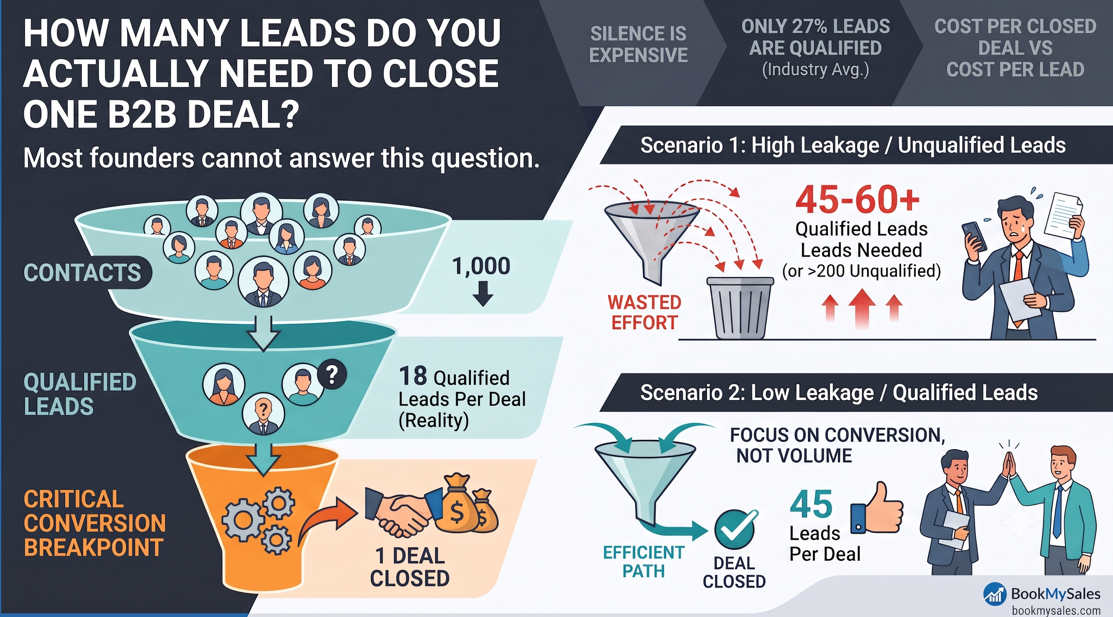
How Many Leads Do You Actually Need to Close One B2B Deal?
Most founders cannot answer this question. They can tell you their revenue target. They can tell you their average deal size. Ask them how many conversations sit behind one signature and the room goes quiet.
That silence is expensive.
The short answer
For a typical Indian B2B services or manufacturing sale with a deal value between ₹5 lakh and ₹50 lakh, you need somewhere between 45 and 60 qualified leads to close one deal. If your leads are unqualified, that number climbs past 200.
The range is wide because the number is not really about leads. It is about how much leakage sits between the first conversation and the signature.
Where the funnel actually breaks
Here is a realistic conversion path for a mid-market B2B sale, built from the numbers we see across managed accounts:
About 30% connect — that leaves you 300 real conversations.
Of those conversations, 18% qualify, which is 54 qualified leads.
45% of qualified leads agree to a meeting: 24 first meetings held.
42% of those meetings produce a proposal: 10 proposals submitted.
And 30% of proposals close: 3 deals.
Three deals from a thousand contacts. That is roughly 18 qualified leads per closure — but only if the qualification at stage three was real.
Three deals from a thousand contacts. Eighteen qualified leads per deal at the top, but only if the qualification is real.
Now change one number. Drop qualification quality so that only half your “qualified leads” have budget and authority. The proposal stage collapses, the close rate halves, and you are at 36 leads per deal. Drop it again and you are past 100.
This is why adding leads rarely fixes anything. You are not scaling a funnel. You are scaling a leak.
Only 27% of leads passed to sales are qualified
That figure comes up consistently in lead qualification research, and it matches what we find when we audit an existing pipeline. Nearly three quarters of what a marketing function hands over is not sellable.
Salesforce has reported that sales representatives spend well under a third of their week actually selling. Most of the rest goes to administration and to chasing people who were never going to buy.
Put those together and the picture is clear. Your closers are spending the majority of their time on the majority of leads that were never real.
How to find your own number
You do not need a consultant to do this. You need ninety minutes and honest data.
1. Take the last twelve months. Count every closed deal.
2. Count every lead that entered the pipeline in the same period.
3. Divide. That is your raw ratio.
4. Now count only the leads that reached a first meeting. Divide again. That is your qualified ratio.
If the gap between those two numbers is large, you do not have a lead generation problem. You have a qualification problem, and buying more leads will make it worse.
The number that actually matters
Cost per qualified lead is a vanity metric if the qualification is soft. The metric that survives a board meeting is cost per closed deal, and it is the only one that connects sales spend to the bank account.
A vendor charging ₹800 per lead at 200 leads per deal costs you ₹1.6 lakh per closure. A partner charging ₹4,000 per lead at 45 leads per deal costs you ₹1.8 lakh per closure, and your closers get their week back.
The second one looks five times more expensive on the invoice. It is roughly the same on the outcome, and dramatically cheaper on opportunity cost.
What to do this quarter
Run the four-step calculation above. Write the two ratios on a whiteboard where the sales team can see them. Then set one target for the quarter: move the qualified ratio, not the raw one.
Pipeline volume is a comfort. Pipeline conversion is a business.
BookMySales runs full sales cycle management, appointment setting, and lead generation for organisations that would rather fix conversion than buy volume. Two sales engines, one partner: bookmysales.com
Sources: Salesforce State of Sales; Gartner B2B buying research; Landbase Lead Qualification Statistics
Comments
Leave a comment
Comments are moderated. Your email will not be published.