Everyone wants more leads
More leads do not automatically create more sales. Using the Bermuda Triangle as a powerful analogy, this article explains why high-volume outreach without qualification, ICP precision, and pipeline discipline leads to wasted effort, lost deals, and poor conversions in B2B sales.
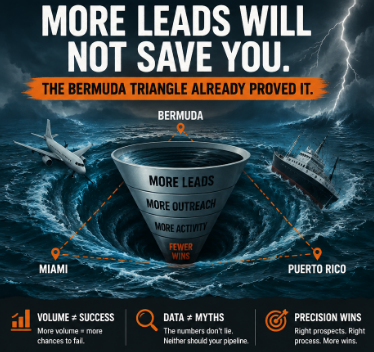
The Volume Mirage: Why More Leads Will Not Save Your B2B Pipeline
The Bermuda Triangle Already Proved It.
For decades, the Bermuda Triangle has been treated as one of the world’s greatest mysteries.
Ships disappeared. Planes vanished. Stories multiplied.
The region between Miami, Bermuda, and Puerto Rico became synonymous with danger.
But when researchers, insurers, and investigators studied the data closely, a different picture emerged.
The mystery was largely manufactured.
Most of the stories ignored context. Most of the claims ignored traffic volume. Most of the fear ignored statistics.
The Bermuda Triangle was not uniquely dangerous. It was simply a heavily travelled region where incidents received disproportionate attention.
And surprisingly, modern B2B sales pipelines suffer from the exact same problem.
The Biggest Myth in B2B Sales
When revenue slows down, most organizations react the same way:
“We need more leads.”
More cold emails. More outbound calls. More LinkedIn messages. More databases. More activity.
The assumption is simple:
If pipeline volume increases, conversions will eventually follow.
But in many cases, volume only creates the illusion of progress.
A bloated pipeline can feel productive while quietly destroying sales efficiency.
Because activity is not the same as momentum. And lead count is not the same as revenue quality.
What the Data Actually Says
The United States records thousands of aviation incidents every year. Only a tiny fraction are associated with the Bermuda Triangle.
Similarly, global shipping studies have repeatedly shown that several other maritime regions are statistically more dangerous than the Bermuda Triangle.
Why?
Because high-traffic zones naturally experience more incidents.
Volume increases exposure. Not certainty.
The same logic applies to B2B sales.
Sending 1,000 cold emails to loosely matched prospects does not create a stronger pipeline. It simply creates more opportunities for:
- Low-quality conversations
- Unqualified meetings
- Poor-fit prospects
- Longer sales cycles
- Wasted bandwidth
- Pipeline clutter
- Forecasting inaccuracies
A sales team chasing 800 weak-fit prospects is not necessarily in a stronger position than a team working with 100 highly qualified accounts.
In many cases, they are simply carrying more noise.
Why Deals “Disappear”
One of the reasons the Bermuda Triangle became legendary was the idea that planes and ships vanished without explanation.
But investigators eventually pointed to far simpler explanations.
Strong ocean currents. Deep waters. Limited recovery systems. Poor historical tracking.
The incidents were not magical. The systems were incomplete.
The same thing happens inside B2B pipelines.
Organizations often describe deals as:
- “Going cold”
- “Disappearing”
- “Ghosting”
- “Getting stuck internally”
But most lost deals are not mysteries.
They are usually the result of missing systems.
Common Reasons Deals Collapse
1. Weak ICP Definition
If your targeting is broad, your pipeline becomes crowded with organizations that were never likely to buy.
2. Poor Qualification Discipline
Without clear qualification checkpoints, weak-fit opportunities continue moving through the funnel.
3. Lack of Exit Criteria
Many sales teams do not define when a deal should be disqualified. As a result, dead opportunities stay alive artificially.
4. CRM Hygiene Problems
Incomplete notes, inconsistent stages, and poor follow-up tracking create forecasting chaos.
5. Activity Without Strategy
High outreach volume without account intelligence usually creates conversations, not conversions.
The problem is rarely “bad luck.” The problem is usually poor structure.
The Organizations That Trust Data Already Know This
If the Bermuda Triangle were genuinely more dangerous than other regions, insurance companies would have priced it differently.
But they did not.
Because insurers calculate risk using data, not mythology.
The same principle applies to B2B sales.
The best-performing revenue teams do not obsess over vanity metrics. They focus on measurable efficiency.
They ask:
- What is our actual close rate?
- Which ICP segments convert fastest?
- What deal characteristics predict success?
- Which outreach channels produce qualified conversations?
- Where exactly do deals stall?
- What qualification thresholds produce the highest revenue outcomes?
When organizations start measuring the right variables, the myth of “more leads equals more sales” begins to collapse.
Precision Beats Volume
More activity does not automatically produce more revenue.
Precision does.
The strongest B2B pipelines are built on:
- Clearly defined Ideal Customer Profiles (ICP)
- Qualification rigor
- Structured outreach systems
- Consistent follow-up frameworks
- Data-backed forecasting
- CRM discipline
- Human-led conversations
- Strong discovery processes
Volume can support growth. But only when the underlying system is already working.
Otherwise, organizations simply scale inefficiency.
Final Thought
The Bermuda Triangle became famous because people believed the story before examining the numbers.
Many B2B organizations make the exact same mistake with their pipelines.
They assume more leads will solve weak conversions. They assume more outreach will fix poor qualification. They assume activity itself is progress.
But pipelines are not built on hope. They are built on structure, targeting, qualification, and execution.
If your sales strategy depends entirely on increasing volume, you may already be navigating without instruments.
About BookMySales
BookMySales builds B2B pipelines through qualification rigor, ICP precision, and structured sales execution.
End-to-end. Human-led. Data-first.
If your organization wants predictable B2B growth instead of pipeline noise, it may be time to rethink the volume-first approach.
Comments
Leave a comment
Comments are moderated. Your email will not be published.