How BMS Took Ecowise Power from Zero Pipeline to Consistent Closures
Ecowise Power had a strong product and a thin pipeline. This is the story of how BMS built their industrial solar B2B pipeline from scratch — using AI-assisted intelligence and a dedicated human team — and what a signed 1100 KWp BOOT deal taught us about the way complex sales actually close.
How BMS Took Ecowise Power from Zero Pipeline to Consistent Closures
A real case study on building a B2B pipeline from scratch — using AI-assisted sales intelligence, a dedicated human team, and a system that doesn't stop when the first deal closes.
Ecowise Power Solutions came to us with a problem that is more common than most founders admit.
The product was genuinely strong. 30+ MW of operational solar capacity. A client list that included TVS Motors, Ashok Leyland, and Royal Enfield. A business model — rooftop solar on BOOT terms — that offered industrial buyers something extraordinary: zero capital investment, a fixed power tariff for the entire contract period, and full ownership of the plant at the end of it.
By every measure, this was a product that should have been selling itself.
It was not.
The pipeline was thin. Qualified conversations were rare. Closures were slower than the business needed. And the team was spending enormous energy on outreach that was not producing the kind of traction that matched the product's actual potential.
This is the story of what we built together. And what it produced.
- First, understand why industrial solar is one of the hardest B2B sells in India.
Most people assume that if the numbers work, the deal follows. In industrial solar, the numbers almost always work. BESCOM grid power for a large HT2A consumer in Karnataka costs upwards of ₹8.52 per unit when you factor in the base tariff, fuel adjustment charges, power and general surcharges, taxes, and true-up charges. A BOOT arrangement at a fixed solar tariff saves the buyer meaningful money on every unit — from day one.
And yet, deals stall constantly. They stall because the conversation never reaches the right person. They stall because the person who receives the pitch cannot translate it into language their CFO or promoter will act on. They stall because solar companies pitch the product without first understanding the buyer's specific energy mix — their BESCOM units, their wheeled captive power, their DG dependence — and so the proposal lands without the precision that creates conviction.
A BOOT deal is not a product sale. It is a financial decision, a risk assessment, a long-term commitment, and a relationship — all at once. The buyer is signing a 7 or 10-year agreement, providing a bank guarantee, and allowing a third party to install infrastructure on their roof. The conversation that gets you there cannot be a pitch. It has to be a partnership conversation.
Most solar companies do not have the sales infrastructure to hold that kind of conversation at scale.
That is the gap we were asked to close.
- We did not start with outreach. We started with intelligence.
The first thing BMS built was not a lead list. It was an account intelligence framework.
Using AI-assisted analysis, we mapped the industrial landscape in Karnataka — identifying high-consumption manufacturers most likely to have significant BESCOM grid exposure, existing third-party wheeled power arrangements, and a decision-making structure that could move on a long-term energy contract.
This is where most sales efforts go wrong. They target by sector or geography and call it targeting. Real targeting means knowing, before you make the first call, whether the buyer's current energy cost structure creates a genuine case for switching. It means knowing which units in their bill are vulnerable to solar displacement and which are not. It means walking into the conversation with a savings estimate, not a brochure.
This is what Claude — the AI system at the core of our sales intelligence layer — made possible. Not as a replacement for human judgment. As a force multiplier for it.
For priority accounts, we modelled the likely bill structure before any conversation took place. Demand charges, energy charges, fuel adjustment costs, wheeled unit volumes, tax burdens. We knew the buyer's world before they invited us into it. And that changed the quality of every conversation that followed.
- The human layer is where the deal actually lives.
AI handles intelligence. Humans handle trust.
Sireesha, Our dedicated account resource on the Ecowise engagement, is not a telecaller running a script. She is a sales professional who understood the product deeply, spoke the language of industrial energy buyers, and had the patience and persistence that complex B2B demands.
In industrial B2B, the decision-maker is almost never the first person you reach. There are gatekeepers, plant managers, purchase teams, CFOs, and promoters — and each of them has a different concern. The plant manager wants to know if operations will be disrupted during installation. The CFO wants to know about the bank guarantee. The promoter wants to know what happens if the company exits the arrangement early. The legal team wants to understand the default clauses.
Every objection is legitimate. Every concern deserves a real answer. And the only way to sustain that through a multi-month sales cycle is with a human who is genuinely committed to the account — not a rotation of different voices following a checklist.
That consistency is what the BMS model delivers. One dedicated resource. Deep product knowledge. Systematic follow-through. Intelligence-backed preparation for every conversation.
After every sales call, our AI layer processed the conversation — identifying objection patterns, tracking buyer sentiment, flagging unresolved concerns, and informing the messaging strategy for the next interaction. Every call made the next one sharper.
- Then, one day in 3 months time, the term sheet was signed, Followed by another and then another – with a solid pieline, we at BMS closed our largest deal for Ecowise with ten times more committed in pipeline.
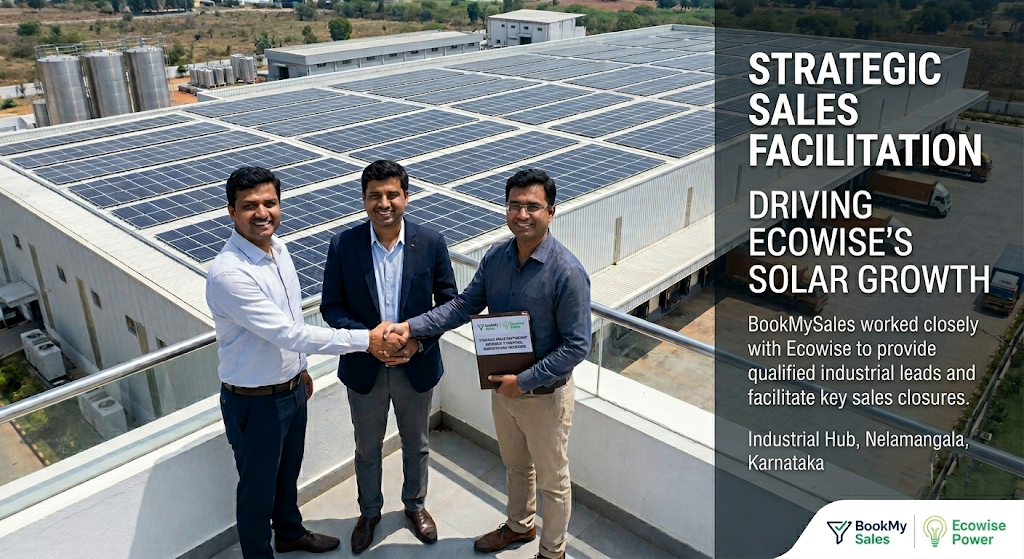
1100 KWp. Rooftop solar BOOT. A large food manufacturing facility in Nelamangala, Karnataka.
Zero capital investment from the buyer. Ecowise builds the plant, owns it, operates it, and at the end of the term, transfers full ownership to the buyer. From that point, the buyer's power cost drops to near zero — just operations and maintenance.
The unit economics inside the deal: a saving of ₹2.02 per unit against the all-in BESCOM rate under the 7-year plan. Across an estimated 1.375 million units generated in the first year alone, that is ₹27.77 lakhs of savings in year one. Over 25 years, the cumulative savings cross ₹21 crore.
The buyer's authorised signatory put their seal on the document.
That is what a pipeline, built correctly, eventually produces.
- But the deal is not the point. The system is the point.
A single closed deal is a milestone. What BMS built for Ecowise is something different — a functioning pipeline architecture that did not stop when the first deal closed.
The account intelligence framework is still running. The follow-up cadences are still active. More industrial accounts are in active conversation. More closures are coming.
This is the difference between a sales hire and a sales system. A hire closes what is in front of them. A system continuously feeds, qualifies, advances, and closes — and gets smarter with every cycle.
The AI layer learns from every conversation. The human layer builds on every relationship. And together, they compound.
- Three things this engagement confirmed about complex B2B sales.
· The first: relationships are not a soft metric. In complex B2B, the signed agreement is the endpoint of a relationship — not the beginning of one. Every interaction before the signature is either building or eroding trust. Sales organisations that treat relationships as a funnel step rather than the actual substance of the sale will always underperform against their product's potential.
· The second: intelligence before outreach is not optional. In the age of AI, walking into a conversation without a prepared understanding of the buyer's world is a choice — and it is the wrong one. The information exists. The tools exist. The question is whether you use them before you pick up the phone.
· The third: persistence without a system is noise. A system without persistence is theory. The combination that actually closes deals is a well-designed process — account selection, pitch engineering, intelligent follow-up — executed by humans who stay with it. Neither the AI nor the human works without the other. Together, they work consistently.
- If any of this sounds like your business, we should talk.
Not every business needs the same system. But most high-value B2B businesses share a version of the same problem: a product that is better than the pipeline it is producing.
If your sales are not growing at the pace your product deserves — if your outreach is generating activity but not conversion — if you have tried lead generation and found that it produces noise rather than revenue — the answer is rarely more of the same.
It is usually a better system.
BMS works on a retainer plus performance model. Our incentive is exactly the same as yours: closed deals. We bring the system, the AI infrastructure, and the human team. You bring the product.
If that sounds like a conversation worth having, reach us at mukund@bookmysales.com or call +91 98861 61482.
Comments
Leave a comment
Comments are moderated. Your email will not be published.