Why Referrals Stop Working: The Hidden Revenue Ceiling in B2B Startups
Referral-based revenue typically stalls between $1M and $3M ARR. Learn why 40% of B2B companies never break past this ceiling and how to build systematic sales infrastructure before your network runs dry.
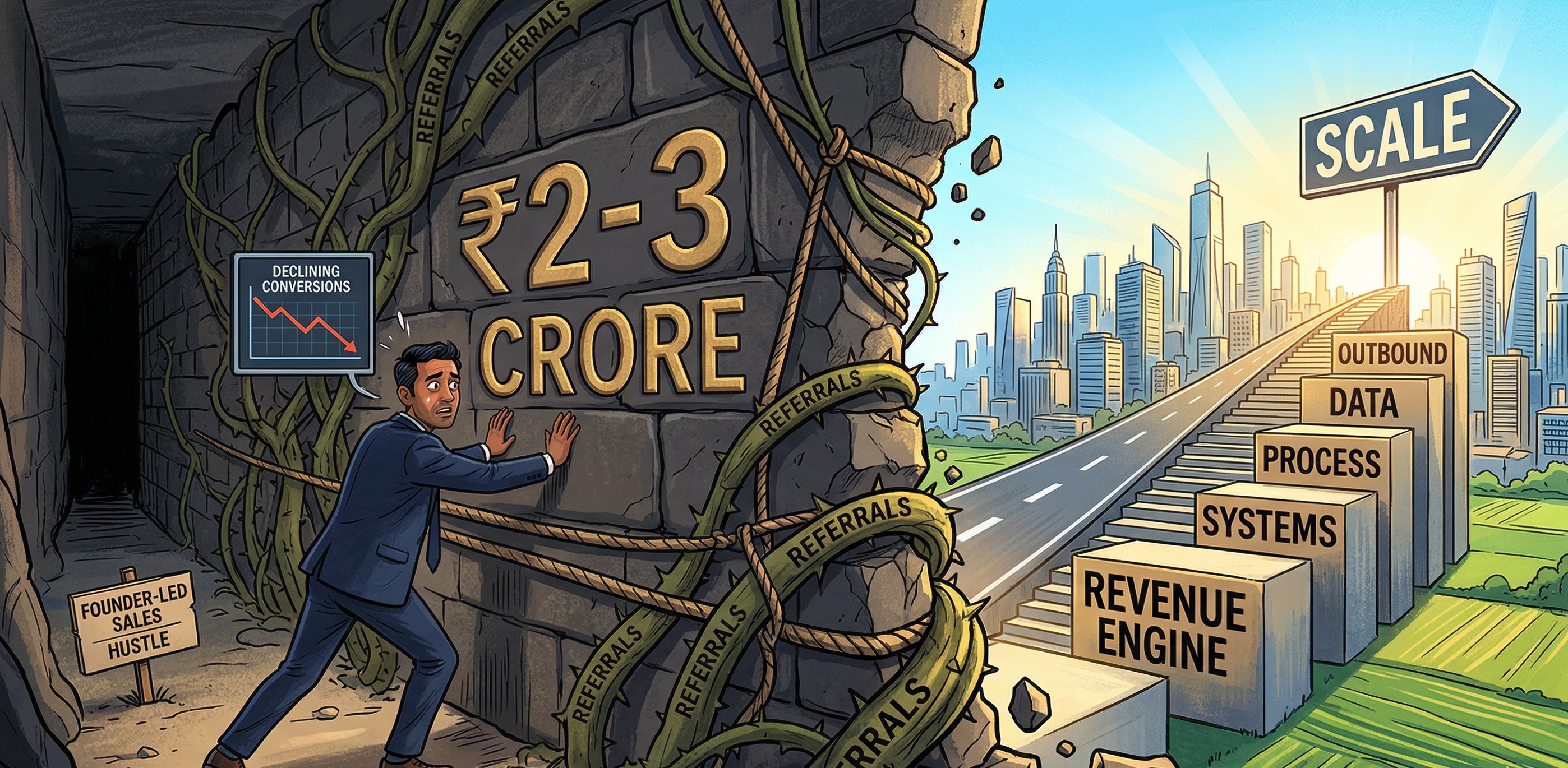
Most B2B startups hit the same wall around the ₹2-3 crore revenue mark. The playbook that built the business, hustle, referrals, and founder-led sales, suddenly stops working. You are putting in more effort, closing fewer deals, and watching competitors with inferior products pull ahead.
The problem is not market saturation or product-market fit. It is the referral trap.
The Seductive Economics of Early-Stage Referrals
Referrals dominate early B2B growth for good reason. The numbers are compelling.
Referral leads convert at 11 per cent compared to 1.5-3.2 per cent for cold outbound. They close 69 per cent faster than non-referral leads. Customer acquisition cost sits around $150 versus $802-$1,980 for other B2B channels. Referred customers spend 13.2 per cent more and retain 37 per cent better.
With economics like these, 82 per cent of SMB owners cite referrals as their primary source of new business. And 84 per cent of B2B buyers start their purchasing journey with a referral.
So what goes wrong?
The $1M to $3M Revenue Wall
Analysis of 10,039 VC-backed SaaS companies by Notion Capital reveals a brutal progression. Twenty per cent never surpass $1M ARR. Forty per cent stall below $3M ARR. Sixty per cent never reach $10M ARR. Only 1.6 per cent reached $100M whilst still private.
The $2.5M to $10M range is precisely where referral-dependent businesses collapse. This coincides with the shift from founder selling to formalised go-to-market, according to Kyle Poyar, formerly of OpenView Partners.
ChartMogul's 2023 SaaS Growth Report confirms that only 13 per cent of SaaS startups reach $10M ARR even after a decade in operation.
The referral trap does not feel like a trap because it works brilliantly at first. Warm introductions come pre-sold on your credibility. There is no cold outreach rejection, no ad spend, no failed campaigns. And it validates the ego: "People are seeking us out."
But referral-based growth has three structural flaws that become fatal at scale.
Flaw One: Unpredictable Pipeline
You cannot forecast what your network will deliver next quarter. One strong referral partner takes a new job, and your Q3 projections collapse.
The mathematics are unforgiving. If your current network generates four to six qualified referrals per quarter with a 50 per cent close rate, you are looking at two to three new clients quarterly. Even if you increase networking effort tenfold, you might push that to five or six new clients. A 2x improvement for a 10x investment.
B2B deals require 3:1 to 4:1 pipeline coverage to hit quarterly targets. When reps start a quarter with 3.2x or higher weighted pipeline coverage, they hit quota 89 per cent of the time. Below 2.8x, attainment drops to 52 per cent.
Referrals alone cannot reliably fill pipeline to those levels.
Flaw Two: Founder Dependency
Referrals flow to the founder, not the company. When you hand off warm leads to a new hire, conversion drops 40-60 per cent. The trust was personal, not institutional.
SaaStr recommends founders personally close the first $1M in revenue before hiring salespeople. Andreessen Horowitz advises that many technical founders stay deeply involved through $10M ARR for enterprise-priced products.
But this creates a dependency that proves nearly impossible to transfer. The first VP of Sales hire is one of the riskiest decisions a scaling company makes. By SaaStr's estimate, 70 per cent of first-time VP of Sales hires do not survive 12 months.
Flaw Three: Network Exhaustion
Every network has edges. Only 29 per cent of satisfied customers actually make referrals despite 83 per cent saying they would be willing to.
The distribution follows a sharp power law: 20 per cent of advocates generate 80 per cent of all referrals. After 18-24 months of aggressive referral mining, you have tapped first-degree connections. Second-degree referrals convert 50 per cent worse. Third-degree? You are back to cold outreach, but without the systems to do it well.
What Predictable Revenue Actually Requires
Scaling past referrals means building sales infrastructure that generates pipeline independent of who you know. This does not mean abandoning referrals. It means making them 20 per cent of your acquisition strategy instead of 80 per cent.
According to Jason Lemkin at SaaStr, at least 20 per cent of new customers should come from referrals and word of mouth, ideally 50 per cent, but no more.
The remaining percentage comes from three areas.
First, outbound systems independent of warm introductions. Targeted prospect lists, multi-touch sequences, and value-first outreach. B2B buying now involves six to ten decision-makers per deal, and closing requires an average of eight touchpoints with enterprise deals demanding over 400 touchpoints across the buying journey.
Second, repeatable sales processes. Discovery frameworks, qualification criteria, proposal templates, and objection handling scripts. Companies with formal sales processes generate 28 per cent more revenue than those without. Ninety per cent of companies using a guided sales process rank as top performers in their industries.
Third, data-driven pipeline management. CRM investments return $8.71 for every $1 spent. Sales reps without CRM systems spend only 28 per cent of their time actually selling, with the rest consumed by manual administrative tasks.
The Companies That Broke Through
Atlassian reached over $100M in revenue with zero traditional salespeople, relying entirely on product-led growth and word-of-mouth. But even Atlassian eventually hired enterprise advocates, then a full CRO, and built a channel partner network of 400 plus. Today, at $4.4B in revenue, deals under $50K remain self-serve, but anything above $100K requires dedicated human engagement.
HubSpot pioneered inbound marketing as a methodology but built systematic sales infrastructure through Mark Roberge's data-driven approach. By 2024, HubSpot had reached $2.63B in revenue with 258,000 plus customers. Even at that scale, 33 per cent of new customers still come from word-of-mouth, but systematic sales converts the other two-thirds.
Slack stated in its IPO prospectus that growth was largely due to word-of-mouth recommendations. Yet the company invested heavily in formal sales teams, with salespeople comprising roughly 30 per cent of total headcount.
The pattern is consistent: successful companies never abandoned referrals. They built systems that made referral revenue additive rather than existential.
The Transition Window Is Narrow
Building this infrastructure in-house takes 12-18 months and requires absorbing the 70 per cent failure rate on VP of Sales hires.
The optimal transition window is around $1M ARR or 10-25 B2B customers. Begin building sales infrastructure before referrals dry up, not after.
At BookMySales, we operate as your end-to-end sales engine during this critical transition. Unlike marketing agencies that stop at lead generation or traction metrics, we embed as your sales execution team. We prospect, qualify, demo, and close deals on your behalf whilst you build internal capacity. Clients do not get meetings. They get revenue.
Referrals Are a Signal, Not a Strategy
Referral-based revenue is not a growth strategy. It is a signal of product-market fit that founders mistake for a scalable acquisition channel.
The companies that break through the $3M to $10M ceiling share a common pattern: they treat referrals as one input into a multi-channel, process-driven revenue engine rather than the engine itself.
Three insights stand out. The transition window is narrow, so begin building sales infrastructure around $1M ARR before referrals dry up. The cost asymmetry is dramatic, as referral CAC of approximately $150 looks cheap until you calculate the opportunity cost of unpredictable pipeline. And successful companies never abandoned referrals; they simply made them one channel among several.
The data tells a consistent story across thousands of companies. Build the systems before you need them, or join the 40 per cent that never break past $3M.
Sources: Notion Capital 2025, ChartMogul 2023, SaaStr, Forrester 2024, Wharton School of Business, Deloitte
Comments
Leave a comment
Comments are moderated. Your email will not be published.